- Business type: Independent Shopify store, apparel accessories, EU-based, one founder
- Problem: Managing reorder points manually across 400 SKUs with inconsistent supplier lead times
- Agent type: Inventory monitoring + alert agent
- Platform used: Make (Integromat) + OpenAI API + Shopify API
- Monthly running cost: €22/month
- Status: Running since February 2025
The spreadsheet problem at 400 SKUs
Below about 50 SKUs, a spreadsheet with manually-set reorder points works fine. You update it when a supplier changes their lead time, you check it when things feel slow. At 400 SKUs, that system breaks. Not dramatically — it breaks quietly, as things you meant to update slip through, as the SKU that was moving slowly in winter starts moving fast in spring, and the reorder point you set nine months ago no longer makes sense.
The founder running this store knew this. He'd had two stockouts in the previous year on SKUs that weren't moving fast enough to stay on his mental radar. Each one cost him between €600 and €1,400 in lost sales and expedited shipping fees to recover.
What the agent actually monitors
The agent runs every six hours. It pulls current inventory levels and 30-day sell-through rates from the Shopify API, compares them against a set of rules stored in a Google Sheet (which he can update without touching the automation), and calculates a projected days-of-stock-remaining figure for each SKU.
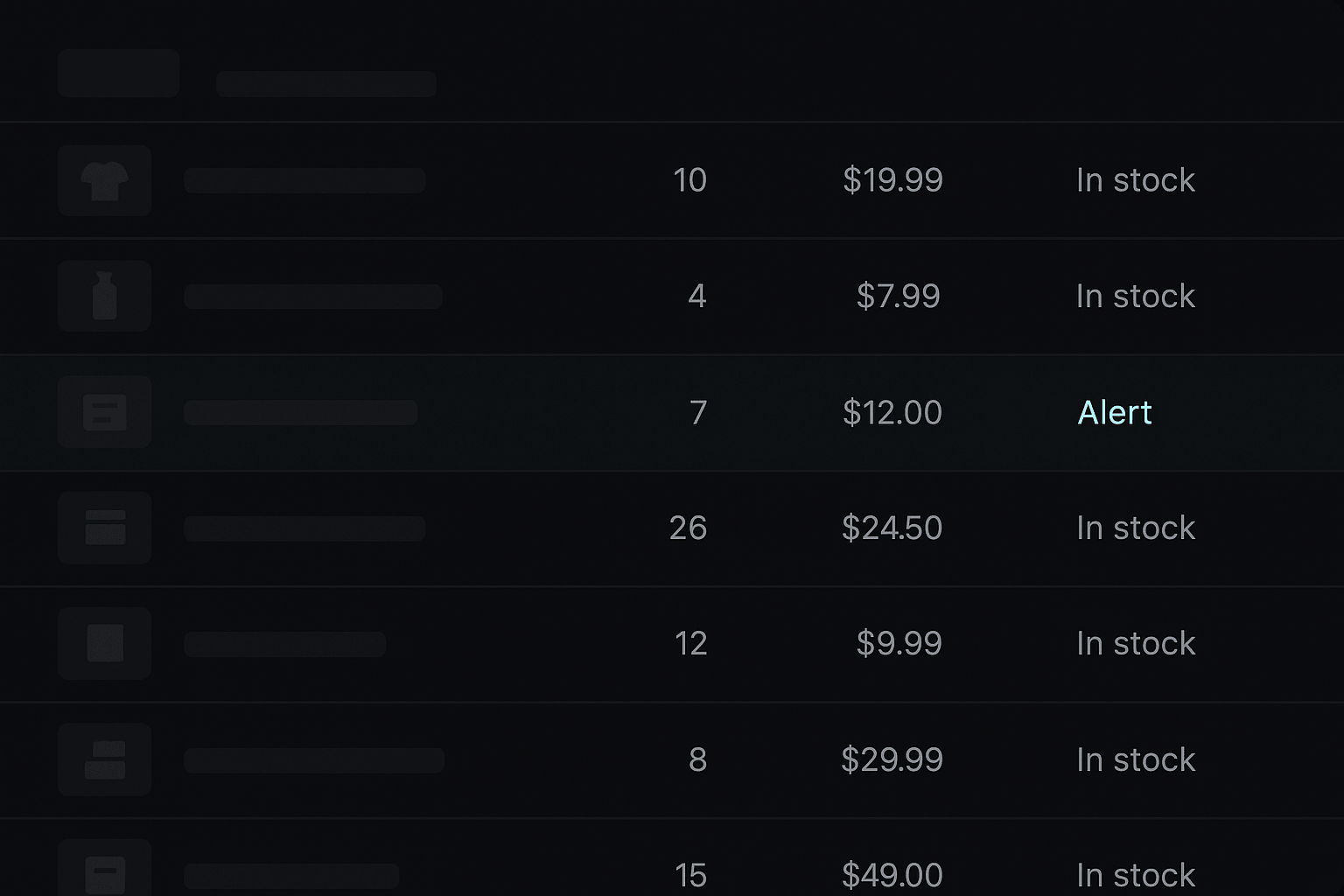
When projected days of stock drops below a threshold — he set it at 18 days initially, then adjusted it per-SKU based on his suppliers' actual lead times — the agent sends an alert to Slack with the SKU, current stock, sell-through rate, days remaining, and a suggested order quantity. He doesn't have to act on it immediately, but the alert exists.
The agent also flags unexpected acceleration: if a SKU's sell-through rate in the last 7 days is more than 40% higher than its 30-day average, it sends a separate "velocity spike" alert, even if the current stock level looks fine. This is what caught both stockouts — not the threshold crossing, but the velocity spike a week before the threshold would have been crossed.
The setup: Make + a Google Sheet as the rules engine
The architecture is simpler than it sounds. The core logic runs in Make (formerly Integromat) — a workflow automation platform. The Shopify connection pulls inventory data. An OpenAI API call does the natural-language formatting of the alert message (he found the plain data format hard to read quickly). A Google Sheets lookup handles the per-SKU configuration.
The Google Sheet acts as what he calls "the brain I can actually edit." It contains a row for each SKU with the reorder threshold in days, the preferred supplier, and any notes. When a supplier changes their lead time, he updates one row. The automation picks it up on the next run.
Total setup: about 14 hours spread over a week, mostly figuring out Shopify's API rate limits and getting the Make scenario structured correctly. No code written. The OpenAI integration uses Make's built-in HTTP module to call the API directly.
Results after four months
The two catches were in February and March. Both were SKUs with seasonally increasing velocity — items that sell slowly in winter and accelerate in spring. In both cases, the velocity spike alert fired 8–9 days before the reorder threshold would have been crossed. He placed orders the same day both times. Neither stockout occurred.
His estimate of the value: roughly €2,100 in prevented lost sales, against €88 in running costs so far. He also notes a harder-to-quantify benefit: he stopped checking his inventory spreadsheet obsessively. The monitoring is happening, and he trusts it, so he's not doing manual checks anymore.
The agent doesn't know about pending orders — items already in transit from a supplier. He handles this by updating a "pending stock" column in the Google Sheet manually when he places orders. It's a small amount of maintenance but it matters: without it, the agent would continue flagging SKUs he's already reordered. He's looked at automating this but hasn't needed to yet.
If this sounds applicable to your situation
The Make + Shopify combination is well-documented and widely used. If you're not on Shopify, similar integrations exist for WooCommerce, BigCommerce, and most other e-commerce platforms. The key variable is whether your platform exposes inventory and sales data via an API — most do.
The Google Sheet as a rules engine is worth noting as a pattern. It keeps configuration out of the automation logic and makes it editable by someone who isn't technical. He could hand the sheet to a VA and they could update lead times without ever touching Make.